The Film Memorabilia Trap: When Rarity Stands In for Meaning
Choose film memorabilia for the story it carries, not its scarcity: build a focused collection that reflects your interests and remains meaningful.
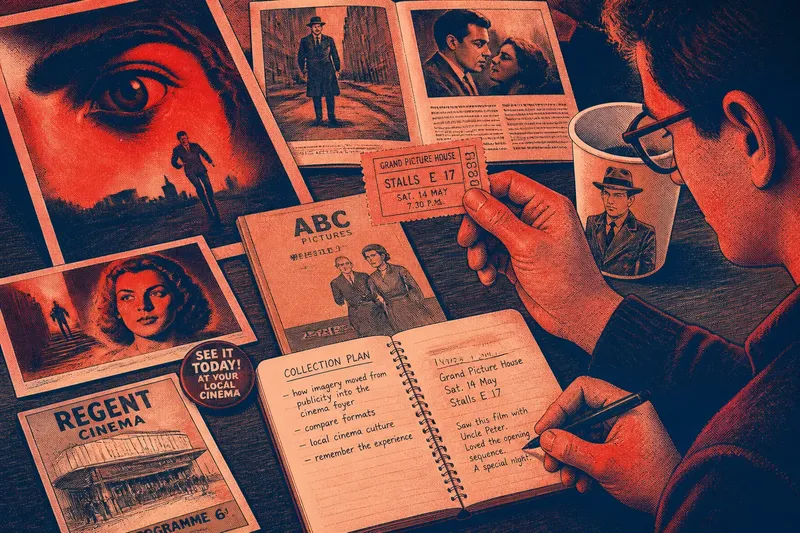
A scarce film memorabilia item can still be the wrong object for your collection. The useful question is not how hard it is to find, but what story it helps you tell: about a film, a design choice, a cinema-going memory or the way an object travelled from screen culture into everyday life.
Rarity can describe supply; it cannot decide significance for you. Sort your collecting by situation before you buy, and the distinction becomes practical: one person needs a memory anchor, another needs evidence for a cultural story, while a third may be better off leaving an intriguing object on the seller’s table.
Start with your reason
Write a sentence that explains what you want the collection to preserve. Keep it narrow enough to guide a decision, but broad enough to leave room for different kinds of objects. “Things connected with films I love” offers little help; “how a particular film’s imagery moved from publicity into the cinema foyer” gives you a useful boundary.
Then ask what an item would contribute that you do not already have. A poster, pressbook, ticket stub, lobby card, badge or cinema-issued cup may all relate to the same title, but they tell different stories. Choose the piece that adds a new kind of evidence or a detail you can explain, rather than another version of what is already represented.
Choose by situation
You are collecting a personal memory
Choose the object that reconnects you to a particular experience, even if it is common. A programme from a much-loved screening may carry more personal weight than an obscure promotional item you have never seen before. Note the memory while it is clear: the venue, who went with you, or what caught your attention. The note is part of the collection’s meaning, not proof of an object’s market value.
Say you find a familiar film’s ticket stub in a box of family keepsakes and remember seeing it with a relative. Imagine adding a short note that identifies the cinema and the shared memory; the observable result is a small archive you can understand later, rather than an anonymous scrap whose significance depends on remembering the story unaided.
You are tracing a design story
Look for objects that let you compare how an image or idea changed across formats. A poster, a press still and a cinema handout might reveal different crops, colours or emphases, even when none is especially rare. Your collection then has a clear question: what changed as the film was presented to different audiences?
Prefer items with enough context to make comparison possible. Record the film title, format, any visible distributor or venue information, and what visual detail interests you. Avoid assuming that an object’s appearance alone establishes its date or purpose; a concise catalogue note can distinguish what you can see from what remains uncertain.
You are preserving local cinema culture
Choose material tied to a place or exhibition practice: a local cinema’s programme, a surviving admission card, or publicity bearing a venue’s name. Here, the relationship between object and location matters more than an impressive scarcity claim. A modest item with legible venue details may support your story better than an unfamiliar collectible with no clear local connection.
Keep the context together. If an object came from a relative or a local collection, record who provided it and what they could reliably say about its use. Treat recollections as recollections, and visible markings as visible markings; that separation makes the collection more useful to someone who did not share the original memory.
You are drawn mainly to rarity
There is nothing wrong with enjoying the hunt, but admit that the hunt is the point. Set a boundary before browsing: a format, film, designer or type of publicity you genuinely enjoy. If an item falls outside it, scarcity alone is a weak reason to buy. You may be collecting the thrill of acquisition rather than building a collection with a story.
What is not worth the effort is chasing every seller’s “rare” label or trying to establish a complete set without knowing why completeness matters. Those claims can consume attention while adding little to your understanding of the films or objects. Ask for the specific basis of the claim, then decide whether that detail changes your interest.
Test the object’s meaning
Before buying, use a short set of questions. They help separate the object’s appeal from the language around it:
- What does it show? Identify the image, text, marks, format and any named venue or distributor.
- What story does it support? State the link to your chosen subject in one sentence.
- What is new here? Name the evidence or perspective it adds to what you own.
- What do I know, and what am I guessing? Keep visible facts apart from seller claims and personal interpretation.
- Will I want to live with it? Consider whether it suits your display, storage and interest without relying on a future buyer’s reaction.
If you cannot answer the story question, pause rather than inventing a connection after purchase. A seller’s description may offer a lead, but it is not the same thing as context you can explain. For condition, authenticity and handling, follow any relevant object or maker guidance; when the evidence matters materially, seek an appropriately qualified specialist.
Meaning questions?
Does rarity make memorabilia valuable?
Not by itself. Scarcity may affect demand, but value depends on what a particular buyer cares about, the object’s condition and the confidence of its identification. For a personal collection, those considerations do not replace the question of whether the item belongs in your story.
How can I tell if an item is significant?
Describe what it connects: a memory, a design decision, a film’s publicity or a particular cinema. Then check whether the object supplies something concrete for that account, such as a visible image, printed wording or venue name. Significance can be personal, cultural or both, but it should not rest solely on an unexplained rarity claim.
Should I buy a common item I already own?
Buy another copy only if it serves a different purpose, such as showing a contrasting design or preserving a version with useful contextual details. If it adds no new information or memory, duplication may simply make the collection harder to care for. A clear reason is more useful than a rule against owning multiples.
What if the story is uncertain?
Keep the uncertainty in the record rather than filling the gap with a confident guess. Note what is printed or marked, who supplied the account, and what you have not been able to establish. An unresolved object can still belong if the question itself interests you.
Build a coherent collection
Coherence does not require every object to be rare, old or expensive. It means a visitor—or your future self—can see why the pieces sit together. A collection about how one film was promoted might include a widely circulated poster, a press still and a local handout because each reveals a different part of that story.
Use a simple catalogue with the item’s name, format, source, visible details and your reason for keeping it. Add a note when an object changes your understanding of the collection. This makes gaps visible, too: perhaps you have several striking images but nothing that connects them to a venue, audience or memory.
When an item does not fit, you can still appreciate it without owning it. Save a seller’s description or make a note of what caught your eye, then return to the collection’s guiding sentence. That small pause keeps film memorabilia collecting centred on the meanings you chose to preserve, rather than on scarcity speaking in their place.