From Painted Palace to Multiplex: The Cinema Facade in Brief
Cinema facade design traces how theatres moved from expressive destination fronts to adaptable venues, and what surviving entrances reveal about moviegoing.
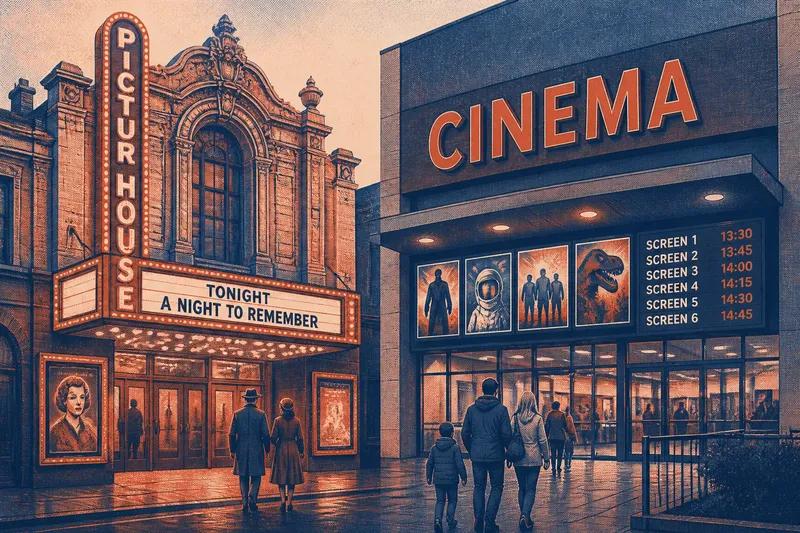
A cinema facade once had to announce that an ordinary street led somewhere extraordinary; later venues often tucked their identity into a shopping centre or a shared urban frontage. Cinema facade design is therefore a record of changing expectations: from the decorated picture house as a destination to the cinema as one part of a larger leisure complex. Looking closely at an entrance, its signs and its relationship to the street can explain the shift without treating every plainer building as a decline.
The facade as invitation
Early purpose-built cinemas competed for attention in busy streets. Their fronts borrowed from theatres, palaces and other public buildings, using ornament, grand doorways and illuminated signs to make a night at the pictures feel like an occasion. The facade did more than identify a venue; it promised a change of atmosphere before a ticket was bought.
That promise could be communicated through a tower, a marquee, a distinctive canopy or a carefully framed entrance. The details varied by place and budget, but the basic task was legible from a distance: draw the eye, make the door easy to find and signal that the building contained a shared spectacle. In some cases, decoration also concealed the practical demands of a large auditorium behind a relatively narrow street frontage.
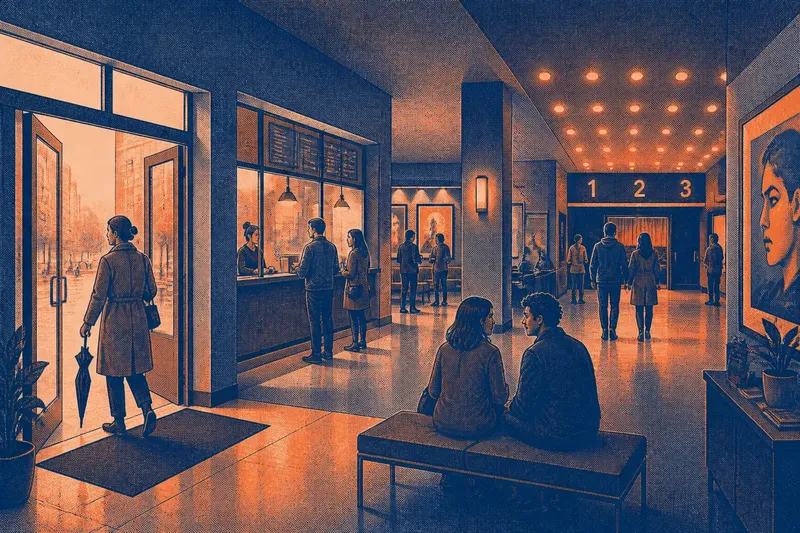
For visitors, the approach mattered. A lit sign or projecting canopy could remain visible in the evening, while a foyer just beyond the doors offered a threshold between the street and the screen. The exterior prepared people for the gathering inside, even before cinema-going became associated with large, purpose-built complexes.
Why grand fronts changed
Purpose-built picture houses were expensive to construct and maintain, and their architecture could be difficult to adapt when a venue changed hands or its programme shifted. As film exhibition developed, operators sought ways to house more screens and serve larger catchment areas. A building designed around a single auditorium and a highly individual frontage did not always fit that business model.
Urban development also changed where cinemas appeared. Some occupied high streets; others became part of shopping centres, retail parks or mixed-use developments. In those settings, the cinema might have no independent street elevation at all. Its identity could sit behind a shared entrance, on a directory, or above an escalator, with the surrounding development doing much of the work of attracting visitors.
More adaptable fronts made it easier to update branding, replace signs or reorganise customer routes without remaking an entire architectural composition. This did not mean that every later cinema was plain, or that ornament vanished. Rather, the facade’s role became less singular: it had to operate within a larger site, respond to changing tenants and communicate clearly across several screens.
Multiplex visibility
The multiplex brought a different problem of recognition. A visitor might be choosing between several films in one building, not deciding whether to enter a solitary picture palace. The exterior therefore needed to identify the cinema and help people find the entrance, while the programme and screen allocation could be communicated through changeable displays.
Large lettering, backlit panels and digital signage suit this flexible role. They can announce a brand or current releases without requiring the whole building to be redesigned. In a shopping centre, the cinema’s frontage may be a sign and a set of doors along an internal concourse; at a retail park, a broad illuminated sign may face a car park rather than a traditional high street.
This arrangement can make the venue easier to update, but it can also reduce the sense that the cinema is a distinct civic destination. A visitor may remember the film or the complex more readily than the building’s exterior. That is a change in how the facade participates in moviegoing, not proof that contemporary audiences care less about the cinema itself.
Reading a cinema facade
When comparing an older picture house with a multiplex, separate the building’s original design from the signs added later. Look for the entrance’s position, the scale of the canopy, the relation between street and foyer, and any surviving features that frame the doors. These clues reveal how the venue addressed people approaching on foot, rather than only how it appears in a photograph.
Then consider what the facade has to communicate now. A cinema in a shared development may rely on wayfinding from the car park or concourse. A converted theatre may preserve a grand entrance but use modern signs to identify its current operator. A street-front cinema might combine old masonry with a new marquee. Each solution reflects a different balance between recognition, access and flexibility.
- Entrance: Is the main door obvious from the street or route through the complex?
- Signage: Does it identify the cinema, the current programme, or both?
- Canopy and lighting: Do they mark a sheltered threshold or mainly carry advertising?
- Surrounding frontage: Does the venue stand alone or share its visual space with other businesses?
- Older details: Are original features preserved, covered, or incorporated into newer branding?
The answers are more useful than a simple old-versus-new judgement. They show whether a facade was designed to draw people from the pavement, direct them through a shared site, or keep the cinema identifiable as the building around it changes.
Common reading problems
Why does an old cinema look less grand now?
Its original frontage may have lost a marquee, decorative lighting or distinctive lettering, while later shops or road changes altered the view from the street. Compare old architectural features that remain with newer signs and cladding; this helps distinguish a genuinely modest design from a once more expressive front that has been changed.
Why do multiplexes use so much signage?
A multiplex has several screens, changing programmes and often a position inside a larger complex, so signs must identify both the venue and the route to it. Notice which panels carry the cinema’s name and which direct visitors to films, ticketing or entrances; the difference explains why the exterior can feel more like wayfinding than decoration.
Can a cinema facade still feel distinctive?
Yes, even when it shares a building with shops or offices. A recognisable canopy, a strong entrance composition, carefully placed lighting or a consistent sign can give the venue a clear identity without recreating a palace-style exterior.
What does a converted cinema entrance reveal?
It can show how a building’s former public role has been retained, adapted or obscured. Look for a broad original doorway, a blocked marquee fixing or a foyer opening that no longer aligns with the current entrance, then consider how the newer use has redirected visitors.
What preservation can retain
When an older cinema is reused, preserving every decorative surface may not be practical, but the entrance can still carry a legible part of its history. Retaining a canopy, original lettering, a sculpted surround or the proportions of the doorway can preserve the building’s public character. These features matter most when they remain visible from the approach people actually use.
Adaptation also asks designers to reconcile old and new signs. A contemporary display can sit beside historic details without pretending to be original. The clearer the distinction, the easier it is for visitors to understand both the current venue and the older building they have entered.
Say a former single-screen cinema becomes a multi-screen venue in a town centre. Its new operator could retain the old entrance surround, add restrained illuminated lettering above the doors and place current listings inside the foyer. People approaching from the pavement would still recognise a cinema entrance, while the changeable programme would not require the historic facade to carry every detail.
Not every venue needs elaborate decoration, and recreating a vanished palace frontage is rarely worth the effort if the building, setting and audience no longer support it. The more useful question is whether the entrance can be found, understood and remembered in its present surroundings.
Facade as public memory
A cinema exterior records more than architectural fashion. It shows how exhibition moved from a dedicated building that announced itself to a venue increasingly integrated into retail and leisure spaces. The shift is visible in the changing relationship between doorway, street, signs and programme: the facade once made the cinema itself the event, while many later fronts help visitors locate one attraction among several.
That distinction gives a practical way to read any cinema building. Start with the route a visitor takes, identify what the frontage makes visible, and separate enduring architectural features from replaceable branding. Cinema facade design becomes easier to understand when judged by the invitation it makes to its surroundings—not by whether it resembles a painted palace.