A Home Screening Built Around One Director’s Visual Motif
Plan a home screening around one director’s visual motif, pair two films thoughtfully and give guests a prompt that opens conversation without quizzing them.
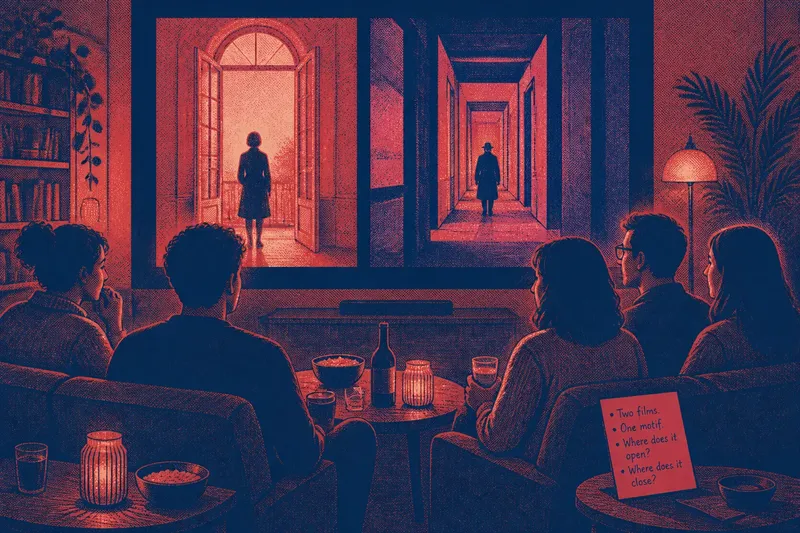
A home screening built around one director’s visual motif works best when the images, not a lecture, set the evening’s pace. Choose two films in which a recurring shape, colour, frame or movement invites comparison, then give guests one open prompt to carry from the first viewing into the second.
The occasion can feel carefully composed without turning into a film class. Your job is to make the connection visible, leave room for different readings and choose a pairing that suits the people in the room.
Choose the motif first
Start with a visual detail you can point to in both films: doorways, windows, mirrors, circles, long corridors, a particular colour, or characters framed at a distance. The motif need not mean the same thing each time. A repeated image becomes interesting precisely because context can alter its effect.
Keep the idea narrow enough to notice but broad enough to appear naturally. “Blue” may be too loose unless you have a reason to follow it, while “blue light around moments of hesitation” offers a more useful thread. Avoid deciding in advance what the motif must signify; that can make the evening feel like a hunt for evidence.
Choose films by the same director, as the occasion requires, and look for a connection you can describe in one plain sentence. For instance: “Both films use doorways to make a character seem separated from the room.” That is an invitation to look, not a claim that settles the interpretation.
Three pairing approaches
Follow one shape
Pair films in which a repeated shape—such as a frame within the frame, a circle or a corridor—changes its relationship to the characters. One film might make a doorway feel welcoming; the other might use a similar doorway to suggest distance. This approach suits guests who enjoy noticing composition and comparing images without needing specialist vocabulary.
It is also a good choice when the films differ in story or mood. The visual thread gives the evening a centre, while contrast prevents the second film from feeling like an encore. Pick a shape that can be noticed in a still image as well as in a moving scene, so guests have a clear point of entry.
Track a colour
A colour pairing is accessible and easy to introduce: follow red, green, gold or another hue through each film, then consider how lighting and surrounding colours change its effect. This works well for guests who respond to atmosphere and production design more readily than to camera terminology.
Colour alone can become a scavenger hunt. Give it a more particular angle, such as where the colour appears, what it sits beside, or whether it draws the eye towards or away from a face. Keep the wording observational rather than symbolic; the same colour may carry different associations for different viewers.
Compare a camera movement
Look for a repeated movement, such as a slow approach, a pan that reveals a room, or a shot that holds after a character leaves. This pairing suits a group interested in how a scene guides attention over time. It also creates a natural comparison between films that use a similar movement with different emotional weight.
This approach asks for more concentration, so choose it when guests are comfortable watching closely and the films leave room for pauses in discussion. Avoid making the evening depend on identifying technical terms. “The camera moves towards the character” is enough to begin a useful exchange.
Match the pairing to guests
Think about what your group enjoys, how much attention they want to give, and whether they are likely to have seen either film before. A shape or colour is usually the gentlest entry point; movement can reward a more focused group. If several guests know one film well, pairing it with a less familiar one can give the evening a shared reference without making prior knowledge a requirement.
Consider tone and viewing energy as well as visual links. Two films with a strong motif but very different emotional intensity may leave guests with little appetite to talk. Conversely, two similarly paced films can make a long evening feel heavy. Choose a pairing whose contrast feels purposeful, and leave enough breathing space between screenings for a drink or a brief stretch.
Say you are hosting friends who enjoy discussing interiors but dislike being asked to name camera techniques. You might pair two films by one director that use windows differently, introduce the idea as “who seems close to the outside world?”, and let guests notice other details as well. The expected result is a conversation with a shared starting point, not a single answer everyone must reach.
Set the room with restraint
Use the room to support attention rather than imitate a cinema. Arrange seats so everyone can see the screen without craning, clear distracting reflections where practical, and keep a lamp available for the interval. A simple place to set drinks helps guests settle in, but avoid putting objects where they block the image or invite constant handling.
A short printed card can name the films and offer the viewing prompt. Keep it spare: a title, the motif in a few words and one question are enough. Skip decorative props that announce the interpretation before anyone has watched; a red napkin or a collection of mirrors can turn a subtle visual thread into a forced theme.
It is not worth pausing the film to point out every instance of the motif. Guests can notice what they notice, and the less obvious moments may be the most rewarding to discuss afterwards. If you want a reference image, save one still from each film for the interval rather than projecting commentary over the scenes.
Keep the prompt open?
What makes a useful viewing prompt?
Ask about an effect, change or relationship rather than requesting identification. “When did the doorway feel inviting, and when did it feel like a barrier?” allows different observations and does not require guests to remember a technical label.
Should guests know the motif beforehand?
A brief hint helps people settle into the evening, but naming every detail can make them watch only for confirmation. Give the broad thread before the first film and save your more specific observation for the interval, if it still feels useful.
How long should the discussion last?
Let the conversation follow the group rather than setting a target duration. One clear exchange may be enough; if people keep adding observations, give them room, and if they are ready to move on, do not turn the prompt into a round-robin.
What if viewers disagree?
Ask what in the image led them to their reading, then leave the difference open. A disagreement can reveal how framing, colour or context lands differently without requiring a verdict on the director’s intention.
Let conversation breathe
After the first film, offer the prompt once and wait. You might ask, “Did the repeated shape change how close you felt to the character?” Guests can answer with a scene, an impression or a question; no one needs to provide a complete interpretation.
During the interval, resist the urge to explain what the motif “really” means. If someone mentions an image, invite a comparison with the first film or ask what changed around it. Keep the exchange tied to what was visible: framing, light, placement, movement and the character’s relation to the space.
After the second film, make room for the motif to disappear from the conversation. Guests may want to talk about performance, sound, pacing or a scene that had no apparent connection to your plan. That is not a failure of the design; the motif has done its work if it helped people look more attentively, even briefly.
Make the choice
Choose a shape when you want a clear visual anchor and an easy route into comparison. Choose colour when atmosphere is the group’s natural conversation, and choose camera movement when guests are ready to watch how attention shifts over time. In every case, favour a pairing whose connection can be noticed without being explained in advance.
A home screening built around one director’s visual motif needs little beyond two films, a considered order, a comfortable room and one open question. State the connection lightly, let the images do most of the speaking, and allow the final conversation to wander towards whatever the guests genuinely saw.